The Least Likely
In first-century Israel, becoming a talmid — a disciple — was not a given. It was earned.
A Jewish boy began his education at around age five, memorising the Torah under a local teacher. By ten he was working through the oral tradition. The sharp ones, the ones who showed exceptional promise, were invited to continue. The rest went home to learn the family trade. By the time a boy was thirteen or fourteen, most had already been filtered out.
The rabbi was everything in this world. He was not just a teacher of information — he was a living embodiment of Torah. To become his talmid was the highest aspiration a young man could hold. But the rabbi did not take just anyone. He watched. He tested. He questioned. He was looking for students who had what it took to become like him — to carry his interpretation of Torah forward into the next generation.
When a rabbi chose you, he said: Come, follow me. I believe you can become like me.
When he didn’t choose you, the message was just as clear: You’re not good enough. Go home.
Most went home.
Then Jesus shows up on the shore of the Sea of Galilee.
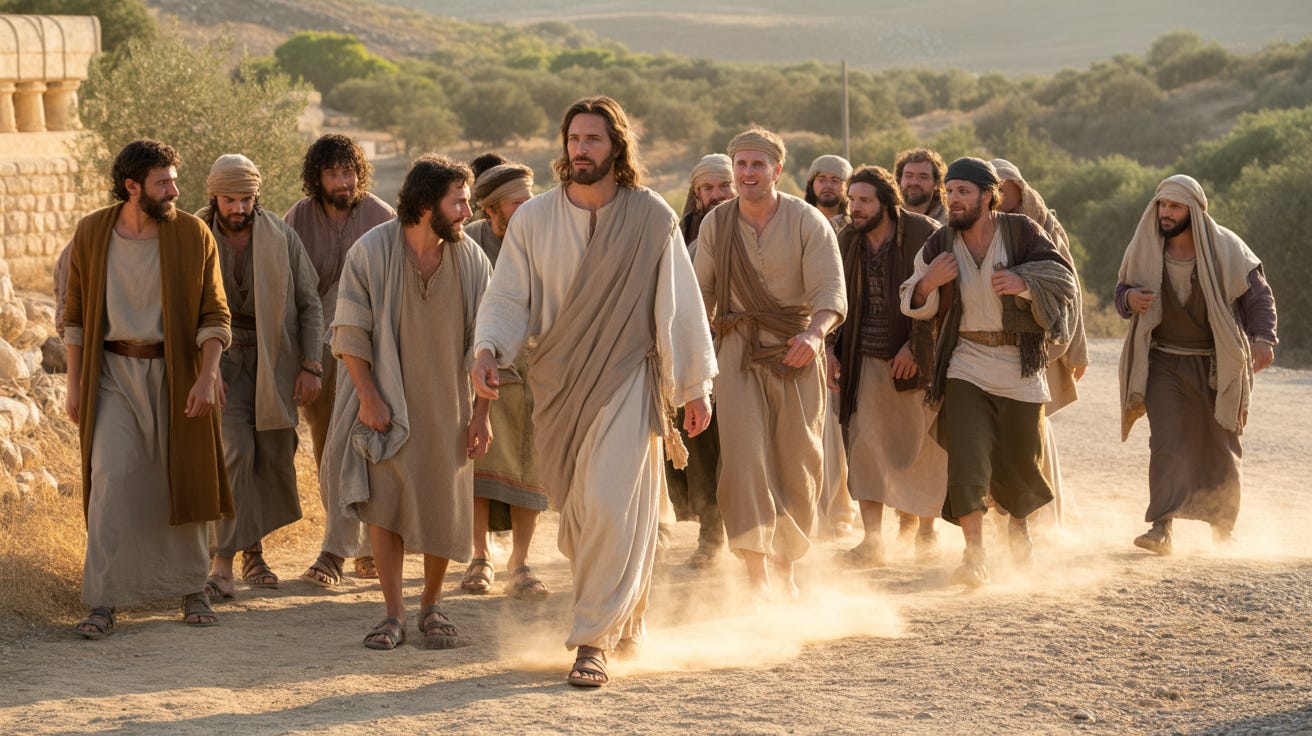
He doesn’t walk into the rabbinical schools. He doesn’t recruit from the top of the class. He finds fishermen. Working men. Men who had already been passed over by every rabbi worth following. They were not in school anymore. They were in boats, doing what boys did when the system had told them they didn’t make the cut.
And Jesus looks at them and says: Follow me.
That moment is more radical than we usually let ourselves feel. These were not the best candidates. They were not the most theologically trained. By every measurable standard of their culture, they were the least likely to carry anything significant into the world.
Jesus chose them anyway.
He didn’t choose them because they were impressive. He chose them because God had a plan for their lives that no rabbi’s filter could see. He looked at Peter and saw a rock. He looked at rough, uneducated fishermen and saw the men who would turn the world upside down. He invested in them. He poured himself into them. He ate with them, travelled with them, argued with them, challenged them, restored them when they failed. He believed in them when they didn’t believe in themselves.
The key was not their qualification. The key was his investment.
He was not looking for polished students. He was looking for yielded ones. And what he poured into the yielded, God transformed.
Nothing has changed.
The Kingdom still moves through unlikely people. Walk into any church where the Spirit is genuinely at work and you will find them — people who don’t look like leadership material by any natural measure. People with complicated histories. People who came late to faith. People who carry wounds that should have disqualified them. People the system passed over, the culture ignored, the institutions never noticed.
And yet.
Paul said it plainly to the church at Corinth: Not many of you were wise by human standards. Not many were influential. Not many were of noble birth. (1 Corinthians 1:26)
God has always had a habit of choosing the people the world overlooked. Not because weakness is a virtue in itself, but because the unlikely make it obvious that the power belongs to God and not to the person carrying it. The least likely candidate, transformed and sent, becomes the clearest evidence that something supernatural is at work.
This is the heart of apostolic discipleship. It is not identifying the most naturally gifted and investing in them. It is finding the ones God has already marked and pouring into them until what God sees in them becomes visible to everyone else.
Jesus did not discover great men. He made them.
That is the model. That is the mandate. And the least likely people in your world right now may be exactly who he is pointing to.


