
The Fear of the LORD Returns to His House
A reflection on Zechariah 13 and a word the Lord gave me more than twenty years ago concerning the present hour

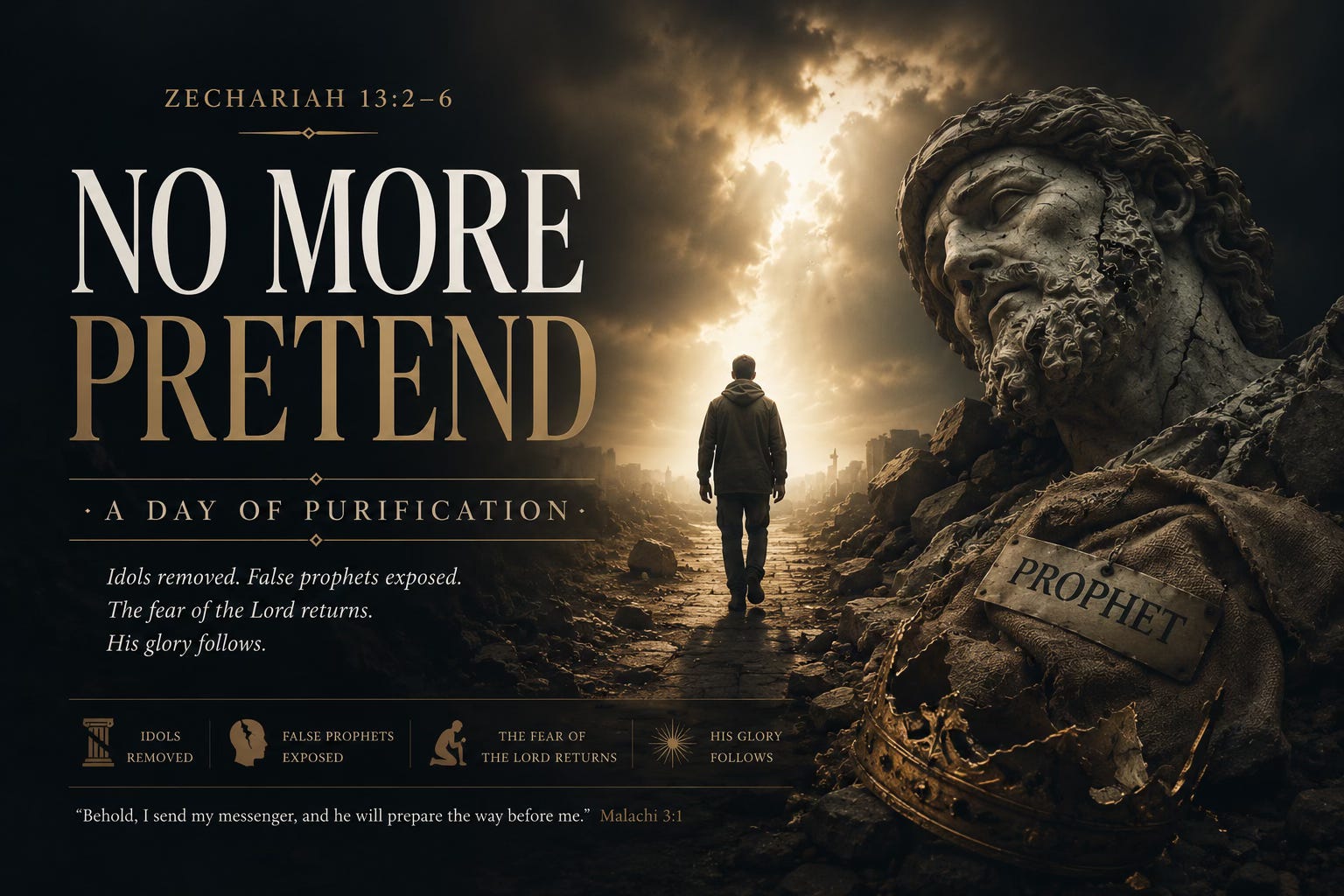
The prophet Zechariah, writing in the closing pages of the Hebrew prophetic corpus, delivered an oracle concerning the dealings of God with His covenant people in a day of great purification; and in the second through sixth verses of his thirteenth chapter, he set down words which the contemporary prophetic movement has, by and large, declined to preach. The text reads as follows:
“‘It shall be in that day,’ says the LORD of hosts,
‘That I will cut off the names of the idols from the land,
And they shall no longer be remembered.
I will also cause the prophets and the unclean spirit to depart from the land.It shall come to pass that if anyone still prophesies, then his father and mother who begot him will say to him, “You shall not live, because you have spoken lies in the name of the LORD.” And his father and mother who begot him shall thrust him through when he prophesies.
And it shall be in that day
That every prophet will be ashamed of his vision when he prophesies;
They will not wear a robe of coarse hair to deceive.But he will say, “I am no prophet, I am a farmer;
For a man taught me to keep cattle from my youth.”And one will say to him, “What are these wounds between your arms?”
Then he will answer, “Those with which I was wounded in the house of my friends.” ’ ”— Zechariah 13:2–6, NKJV
The Lord has given me, over the span of decades in ministry, the burden of meditating upon this passage; and I am persuaded by the weight of the Spirit upon my own life that what Zechariah saw concerning Israel in the day of her purifying is, in measure, what the Spirit of God is presently doing in the prophetic ministry of the Western Church. Idols and false prophets paired in the same indictment; the protective inner circle dismantled; the costume of the prophet cast off in shame; the wounds of the seer revealed to have been inflicted in the very house of his friends. This is the oracle, and this is the hour.
A WORD I HAVE CARRIED FOR TWENTY YEARS
More than two decades ago, in a season of fasting and seeking the face of God concerning the future of His Church, the Lord impressed upon me a word which I have carried, prayed over, and watched unfold in the years since. He showed me that a move of purification was coming upon the Body of Christ; not first a move of revival, not first a move of harvest, but a move of cleansing. And He showed me, with particular emphasis, that this purification would touch the prophetic ministry itself; that the office which had been raised up in the late twentieth century to recover the voice of God to His people would not be exempt from the very fire it had so often proclaimed upon others.
I confess that, at the time, I did not fully understand the weight of what I had been shown. I had laboured for years alongside men and women of genuine prophetic gifting; I had witnessed the recovery of the office of the prophet within the Church; I had rejoiced in the restoration of charismata to congregations that had for generations preached against them. And yet the Lord said: this also will be purified. He said it tenderly, but He said it without negotiation; for the integrity of His name in the earth could not be left in the hands of a movement increasingly compromised by self.
In the twenty years that have passed since that word was given to me, I have watched, with grief and with sober expectation, the deepening drift of the prophetic stream. What was once a trembling office has become, in many quarters, a platform; what was once an oracle has become a commodity; what was once a coal from the altar has become a content calendar. The prophetic ministry that I knew in its purer days has, by the testimony of its own most public expressions, become deeply erroneous and self-serving. Not in every corner, certainly, and not without notable exceptions of integrity; but as a movement it has drifted from the trembling that birthed it, and the drift has been visible to anyone with eyes to see.
And now the Lord is doing what He said He would do. He is restoring; He is cleansing; He is purifying. The fire that the prophets so often pronounced upon the world has, at last, been kindled in the prophets’ own house.
A DIVINE PATTERN: TREMBLING FIRST, GLORY AFTER
There is a divine pattern threaded through the whole of Scripture, and the contemporary Church, in her hunger for the visible and the immediate, has largely forgotten it. The pattern is this: the fear of the LORD always precedes the glory of the LORD. When Moses ascended Mount Sinai, the mountain trembled before the cloud descended (Exodus 19:18); when Solomon dedicated the temple, the priests could not stand to minister because of the weight of the glory (1 Kings 8:11); when Isaiah saw the Lord high and lifted up, the doorposts of the temple shook at the voice of the seraphim who cried Holy, Holy, Holy (Isaiah 6:4). The pattern does not vary, and it cannot be circumvented; trembling first, glory after; reverence first, cloud after; awe first, fire after.
What we are presently witnessing in the Western Church is the LORD reestablishing this ancient pattern. He is awakening the saints to the weight of His name; He is reintroducing His people to the terror of His holiness, not a terror that drives them from Him but a holy fear that draws them into Him with awe. The prophet Malachi declared: “Behold, I send my messenger, and he will prepare the way before me. And the Lord whom you seek will suddenly come to his temple”(Malachi 3:1, ESV). The Lord is coming to His temple; not to a temple constructed of cedar and stone, but to the temple of His Body, the Church of the living God; and He is coming suddenly, which is to say, His arrival will catch those who handle His name lightly entirely off their guard.
THE NATURE OF THE FEAR OF THE LORD
It is necessary, at the outset, to define our terms; for the contemporary Church has so domesticated the language of the fear of God that the very phrase has lost its biblical weight. The fear of the LORD is not the cringing terror of a slave before a cruel master; it is not the dread of judgment that drives the sinner into hiding; it is not, as many in our therapeutic age have suggested, a primitive religious sentiment that the mature believer outgrows on his way to a friendlier theology. The fear of the LORD is something far deeper and far more glorious than any of these caricatures permits.
Consider three biblical contours of this holy fear:
It is an awe of His holiness that reorders every other affection of the soul. When the heart sees God as He truly is, high and lifted up, holy, holy, holy, every other love, every other fear, every other ambition is dethroned from the chambers of the inner man and reduced to its proper proportion.
It is a weight upon the soul that renders flippancy impossible. The Hebrew word kabod, which we translate “glory,” carries the literal meaning of weight or heaviness; and when the kabod of God rests upon a man, that man cannot trifle. Casual speech about God, casual handling of Scripture, casual approach to His presence; all of it becomes unthinkable to the one who has seen Him.
It is a hatred of evil born from seeing God as He truly is. Scripture testifies: “The fear of the LORD is hatred of evil” (Proverbs 8:13, ESV). Not a hatred of people, but a hatred of evil; that very thing which grieves the Spirit, mars the imago Dei in humanity, and nailed the Son of God to the tree. The one who fears God begins to love what God loves and to hate what God hates.
This is the fear that Scripture identifies as “the beginning of wisdom” (Proverbs 9:10); and let it be understood that the word “beginning” here is no minor descriptor. It is the very foundation upon which the entire house of Christian maturity is constructed. To attempt spiritual life without the fear of the LORD is to attempt to build a skyscraper upon sand; it will rise impressively for a season, but it will not stand under the weight of His glory.
JUDGMENT BEGINS AT THE HOUSE OF GOD
There is a sobering principle embedded in the apostolic writings, and it must be reckoned with in this hour with the utmost gravity: “For it is time for judgment to begin at the household of God; and if it begins with us, what will be the outcome for those who do not obey the gospel of God?” (1 Peter 4:17, ESV). The pattern of God’s dealings is consistent throughout the whole of redemptive history. Before God shakes the nations, He shakes His own house; before He purifies the world, He purifies His own priesthood; before He extends mercy to the prodigal in the far country, He calls the elder brother in from the field of his self-righteousness.
This is not punishment, and it must not be misinterpreted as such; this is purification. This is not the wrath of God falling upon His enemies; this is the discipline of God toward His sons; for the testimony of Scripture is that “the Lord disciplines the one he loves” (Hebrews 12:6). And the discipline of the Lord always begins with those who claim His name most loudly, who occupy positions of His representation most visibly, who handle the holy things most intimately. The prophet, the priest, the apostle, the teacher; these stand foremost in the line of His refining fire, not because He loves them less than the rest, but because He has entrusted them with more.
This is precisely why the prophetic ministry is being purified in this hour with such particular and unrelenting intensity. The prophet, by the very nature of his office, claims to speak the words of the living God; and to carry that claim and to handle it casually is to walk in the gravest danger described anywhere in Scripture. The apostle James warns: “Not many of you should become teachers, my brothers, for you know that we who teach will be judged with greater strictness”(James 3:1). If this is so of the teacher, how much more is it so of the prophet, whose every utterance is prefaced with the formula “Thus says the LORD”?
THE REFINER WHO SITS
Hear, beloved, the word of the LORD through His prophet Malachi: “He will sit as a refiner and purifier of silver, and he will purify the sons of Levi and refine them like gold and silver, and they will bring offerings in righteousness to the LORD” (Malachi 3:3, ESV).
Mark the verb that the Spirit chose: He sits. He does not stand impatiently over the crucible, glancing at His watch and wondering when the work will be complete; He does not abandon the metal half-purified, satisfied with the appearance of refinement. The Refiner sits. He sits as long as it takes; He sits until the dross has risen to the surface and been skimmed away; He sits until the silver runs pure; He sits until, looking into the molten metal, He sees His own face reflected back to Him. Then, and only then, does the refining cease.
This is the patience of God toward His prophetic ministry in the present hour; and it is also the weight of God’s intention toward it. He is not destroying the office, for He gave it; He is not abolishing the gift, for He commissioned it; He is restoring it to its sacred dignity. But the dross which has accumulated upon it is substantial, the sitting of the Refiner will be long, and the heat applied to the silver will be greater than many in the present movement can presently imagine.
WHAT THE FIRE BURNS
Consider, then, what must burn in this refining hour; consider the dross which has accumulated upon the prophetic gift in the Western Church over the course of recent decades. There are four particular contaminations which the Spirit of God is presently consuming, and every honest seer must reckon with each of them:
There is, first, the casualness of “Thus says the LORD.” The phrase that once silenced kings, brought prophets to weeping, and trembled whole assemblies has been reduced in our generation to a stage device, a closing flourish, a brand identifier. To open one’s mouth and speak as God when God has not spoken is, in the testimony of the whole counsel of Scripture, a sin of staggering proportions; and yet it has become, in many quarters, the very mechanism of platform-building.
There is, second, the merchandising of the gift of God. The trafficking of personal prophecy for profit, the selling of prophetic words at a subscription tier, the prophetic conference circuit constructed as a revenue model; none of this is recognizable as the ministry described in the New Testament epistles or modeled by the Old Testament seers. The gift of God, which Peter rebuked Simon for attempting to purchase (Acts 8:20), has now been retailed back to the very people Peter died to deliver.
There is, third, the celebrity that has displaced the trembling. The prophet of Scripture is most often hidden, weeping, marginal, and unwelcome in the courts of the comfortable; he is the man on the back of the wilderness, in the wadi by the brook, in the inner chamber of intercession, in the cave of refuge from Jezebel. The celebrity-prophet of the contemporary stream is a strange new creature, and it is not a creature of biblical origin.
There is, fourth, the presumption which has mistaken impression for revelation. When the prophetic gift is severed from its proper rootedness in fasting, in solitude, in deep communion with the Word, what remains is a culture of guessing; fleeting impressions broadcast as the very oracles of God, intuitions dressed in the vocabulary of revelation, and the whole apparatus defended with the appeal to “I felt I was supposed to say…”
All of this is presently being weighed in the balance, and much of it is being found wanting, and the fire of God is doing its proper work. Let no man lament the loss of the dross; let every man rejoice that the silver remains.
THE PROPHET WHO WILL BE ASHAMED OF HIS VISION
We return now to the oracle of Zechariah with which we began, for the passage demands closer consideration than its mere recitation will permit. There is coming a day, and I suggest to you, on the basis of the word the Lord gave me twenty years ago and on the basis of what my own eyes have witnessed in the years since, that it is closer than the contemporary prophetic movement supposes, when the very title prophet will be associated with such shame that those who once wore it openly will hide from it. The coarse-hair robe, which was once the badge of prophetic authority (worn by Elijah, by John the Baptist, by countless others in the company of the seers), will, in that day, be cast off as a garment of deception. The man who once stood on platforms declaring “Thus says the LORD” will deny ever having been a prophet at all: “I am no prophet, I am a farmer.”
Consider three observations from this oracle which press themselves upon every honest watchman in this hour:
The first observation is this: idolatry and false prophecy are paired by the LORD in the same indictment. The Spirit, through Zechariah, speaks of cutting off idols and removing prophets in the very same breath; for a word manufactured in the soul of a man and broadcast in the name of God is itself a graven image, a likeness of revelation fashioned by human hands and presented as divine. The contemporary prophetic movement must reckon with the fact that the LORD Himself does not separate these two sins; what we have categorized as zeal, He has categorized as idolatry.
The second observation is this: the silencing comes through the closest relationships. It is not the discernment ministry that confronts the false prophet, nor the deconstruction movement, nor the watchdog blog; it is father and mother, those who love him most, those who taught him to walk, those who would never wish to wound him, who say, “You shall not live.” The day of the protective inner circle is ending; the day in which family, stream, and movement closed ranks around their prophets regardless of accuracy, regardless of character, regardless of fruit, that day is being ended by the LORD Himself.
The third observation is this: the wounds tell the truth that the words concealed. “What are these wounds between your arms?” These are the marks of self-inflicted pagan ecstasy, the cuttings made in the soul-driven frenzy of false prophetic encounter; the same kind of wounds, in fact, that the prophets of Baal inflicted upon themselves on Mount Carmel (1 Kings 18:28). And the haunting answer follows: “Those with which I was wounded in the house of my friends.” The very environment which celebrated his ministry was the environment which wounded his soul; the platform which elevated him was the altar upon which he cut himself; the friends who applauded were, in the end, the friends who did him the greatest harm.
Let no man rage against this passage; let every man tremble before it. And let every prophetic voice in this hour pray, with all the trembling that the fear of the LORD can produce: “Search me, O God, and know my heart; try me, and know my anxious thoughts; and see if there be any wicked way in me, and lead me in the way everlasting” (Psalm 139:23–24).
WHAT THE FIRE RESTORES
The refining of God, however, is not destruction; the refining of God is restoration. What emerges from the furnace in this hour is a prophetic ministry recognizable from the pages of Scripture: a ministry purged of the merchant’s spirit and saturated again with the fear of the LORD. Consider four marks of the prophet that the Spirit is presently restoring:
There is, first, trembling before the word of God is spoken. The genuine prophet does not rush to declare; he waits, he listens, he weighs, he trembles. He confesses with Jeremiah: “There is in my heart as it were a burning fire shut up in my bones, and I am weary with holding it in, and I cannot” (Jeremiah 20:9). The word emerges from the prophet of God because it must, not because the platform requires content for the week.
There is, second, hiddenness as the soil of public ministry. Every prophet of Scripture was formed in obscurity before he was sent into visibility; Moses on the back of the wilderness for forty years; David in the cave for fifteen; John in the desert until the day of his manifestation to Israel; the Lord Jesus Himself in the carpenter’s shop for three decades before three years of public ministry. Hiddenness is not a season the prophet endures on his way to fame; hiddenness is the very soil from which authentic public ministry grows.
There is, third, holiness that costs more than it gains. The prophet of God is not the man whose holiness has been curated for the camera; he is the man whose private life would not embarrass his public message. The fire of God is presently removing from the office anyone who is unwilling to pay the cost of personal sanctification, regardless of how impressive the gifting that has carried them to this point.
There is, fourth, accuracy that comes from listening rather than striving. The prophet does not strain to produce a word; he opens his ear and receives one. Isaiah testifies: “The Lord GOD has opened my ear, and I was not rebellious; I turned not backward” (Isaiah 50:5). The genuine prophet is, first and last, a listener; and the accuracy of his word in the public square is the direct fruit of the depth of his listening in the secret place.
THE COAL FROM THE ALTAR
There is one final picture which must be set before us, and it is perhaps the most decisive of all. When Isaiah stood in the throne room and beheld the LORD high and lifted up, the seraphim crying Holy, Holy, Holy, the doorposts shaking, the house filling with smoke, the prophet did not respond with prophetic boldness, but with prophetic brokenness: “Woe is me! For I am lost; for I am a man of unclean lips, and I dwell in the midst of a people of unclean lips; for my eyes have seen the King, the LORD of hosts!” (Isaiah 6:5, ESV).
Mark the sequence carefully, beloved, for it is the divine pattern for every authentic prophetic commissioning: first the vision, then the woe, then the coal, then the commission. First the vision, which is the eye of the prophet lifted up to behold God in His holiness; then the woe, which is the collapse of the self before the holiness beheld; then the coal, which is the cleansing fire from the altar applied to the lips that are about to speak; and then, finally, the commission: “Whom shall I send, and who will go for us?” (Isaiah 6:8).
Skip the vision, and you will have nothing true to say; skip the woe, and you will not be cleansed of what is in you; skip the coal, and your lips will defile every word that passes through them; skip any one of the three, and the commission you carry was never the LORD’s; it was your own ambition wearing the costume of prophetic vocabulary. The prophet does not climb into ministry; he is undone into it.
WHERE THE FEAR OF GOD DWELLS, HIS GLORY FOLLOWS
Hear this, beloved, and hear it well: where the fear of God dwells, His glory follows. Where reverence returns, the cloud returns. Where trembling returns, the fire returns. God will not pour His weight upon a house that handles His name lightly; but where the saints again learn to bow, where the prophets again learn to tremble, where the elders again learn to lead the people in awe rather than in entertainment, there the glory of the LORD will fill the house, as the kabod filled the tabernacle in the wilderness and the temple in Jerusalem.
This is the great hope of the present purifying hour: not merely that the false will be silenced, but that the true will be glorified; not merely that the merchants will be overturned, but that the worshipers will be unveiled; not merely that the casual will be sobered, but that the trembling will be commissioned with such weight that, when they open their mouths in the assembly, the very atmosphere of heaven will be discernible upon their words.
A HOLY DECLARATION
Therefore let this be our prayer in this hour, and let this be our declaration:
Let the flippant grow quiet. Let the merchants be overturned. Let the trembling return. Let the fear of the LORD rise. Let His glory fill the house.
For the fear of the LORD is the beginning of wisdom; the fear of the LORD is the beginning of authority; the fear of the LORD is the beginning of a prophetic ministry that no longer performs but trembles, that no longer markets but listens, that no longer climbs but kneels. The fear of the LORD is the beginning of everything.
And what emerges from His furnace in this hour will be a generation of prophets, priests, and kings whose lips have been touched by the coal, whose hearts have been weighed in the balances, whose ministries have been stripped of self and saturated with the fear of the LORD. Let them arise. Let them tremble. Let them speak.
And let the glory of the LORD fill His house once more.
If this word has stirred something in you, would you share it with a fellow watchman, a fellow intercessor, a fellow seer? The hour is too sacred, and the stakes too high, for the prophetic ministry to remain as it is. May the LORD raise up a remnant who carry His voice with His fear.
Sobering and necessary. May God have Mercy. We serve a Holy God.
Those words from 20 years ago are the plumb line for now. Thank you for this Word Ap Glenn.
May this weighty potent word cause us as prophets to tremble!