

The church doesn’t need a better room. It needs a better culture.
There is a version of the church renewal conversation that goes like this:
Constantine corrupted the church. The institution is the problem. Get back to houses. Get back to the early church. Then everything will be different.
It sounds prophetic. It travels fast on social media. And it is, at nearly every point, a serious oversimplification — one doing real damage to a conversation the church genuinely needs to have.
Here is what needs to be said plainly: bad history makes bad ecclesiology. When the diagnosis is wrong, the prescription will be wrong. And when the prescription is wrong, the patient doesn’t get better — it just ends up in a different room with the same disease.
The Binary Is the Problem
The renewal conversation keeps getting framed as a forced choice: institution or organism, building or house, Constantine or authenticity, structure or Spirit.
These are false binaries. They feel decisive. But they short-circuit the harder thinking the church actually needs to do.
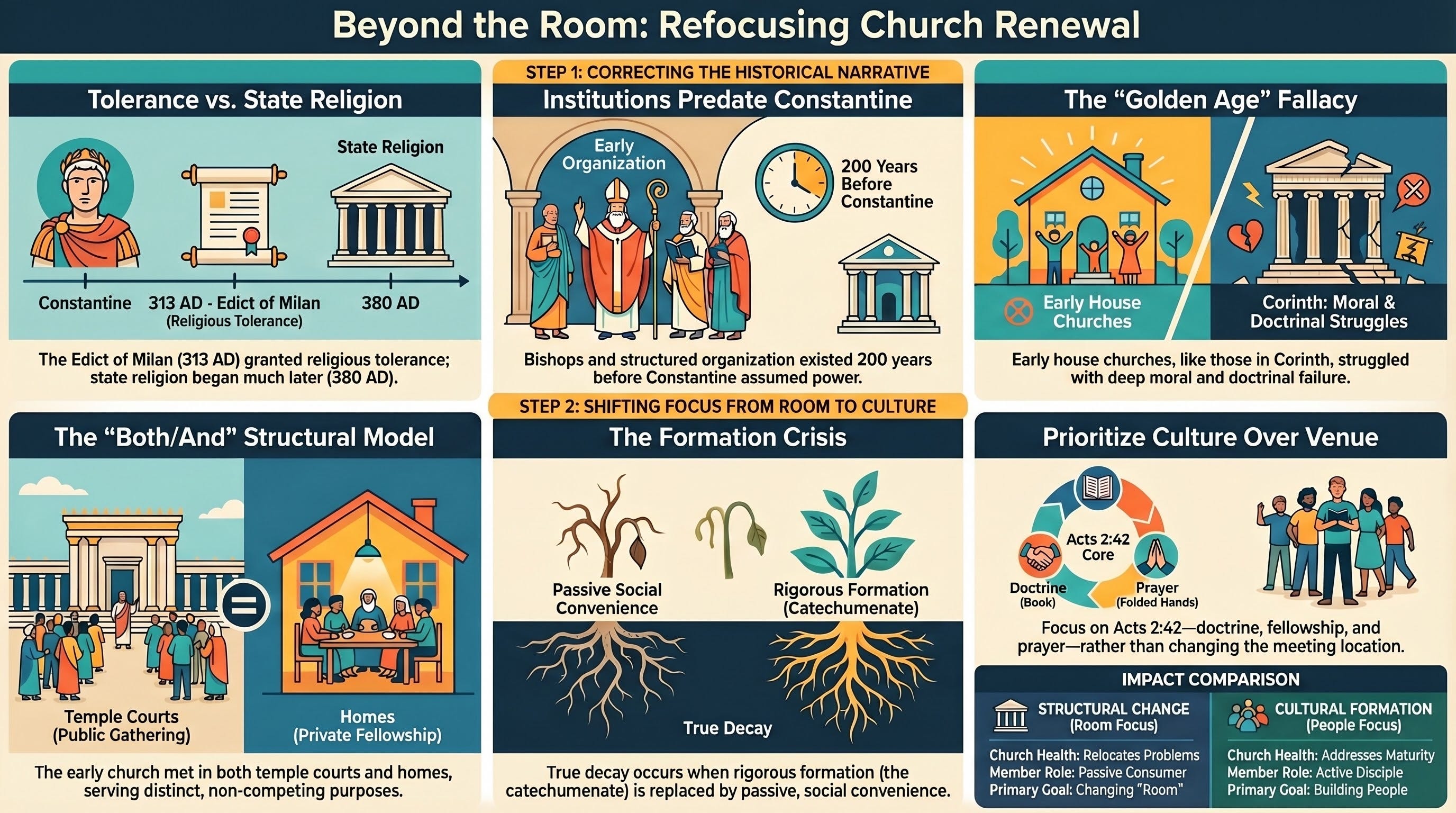
The early church did not choose between large corporate gatherings and intimate household communities. It held both together deliberately — because both served distinct purposes neither could fulfil alone. Acts 2:46 places believers simultaneously in the temple courts and in homes. That is not a tension waiting to be resolved. It is a model waiting to be understood.
The New Testament never identifies structure as the problem. When Paul addresses the disorders at Corinth he does not tell them to disband and meet in smaller groups. He writes two letters calling them to maturity, sound doctrine, and ordered common life. Not one of the seven churches in Revelation is rebuked for meeting in the wrong kind of room.
The problems the New Testament consistently identifies are theological and formational — unbelief, immaturity, false teaching, passivity. These do not yield to architectural solutions. Changing the venue does not change the culture. And it is culture, not structure, that determines the health of any community.
Getting the History Right
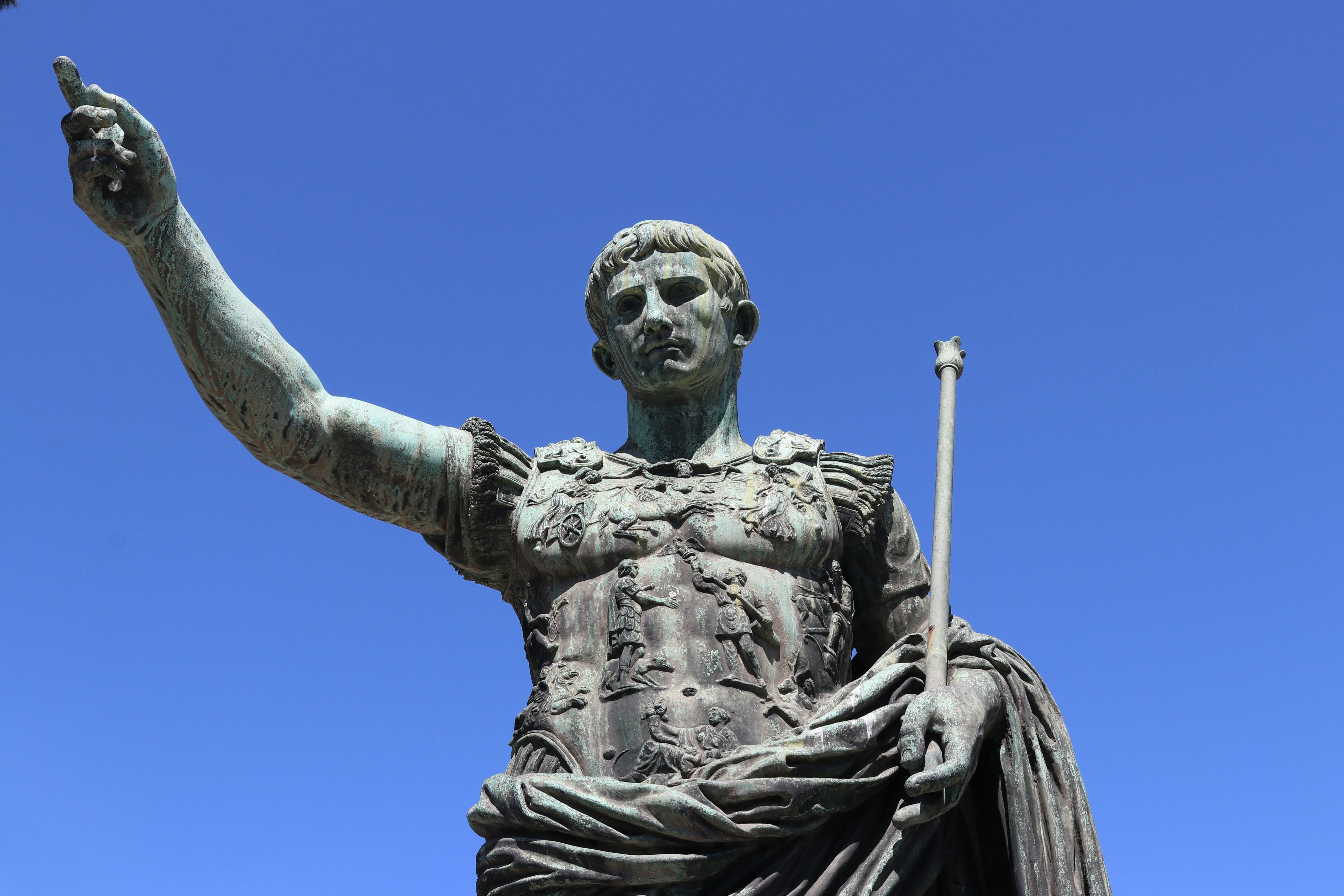
The Edict of Milan (313 AD) is routinely described as the moment Christianity became the official religion of the Roman Empire. This is factually wrong — and it matters.
What Constantine and Licinius actually issued was a broad edict of religious toleration, extending legal protection to all religious communities and ordering the return of properties seized from Christians during the Diocletianic persecution. It was a moment of relief, not a declaration of supremacy.
Christianity did not become the state religion until Theodosius I issued the Edict of Thessalonica in 380 AD — sixty-seven years later, under an entirely different emperor. Collapsing two events separated by nearly seven decades into a single villain moment is not history. It is narrative construction.
More significantly — the church was already institutional long before Constantine arrived.
Rodney Stark’s demographic analysis in The Rise of Christianity estimates Christianity at five to six million people by Constantine’s reign. That scale does not emerge from scattered informal house networks. It requires sustained, structured, multigenerational organisation.
Ignatius of Antioch was writing about bishops, presbyters, and deacons as established realities around 110 AD — two centuries before Constantine. Cyprian of Carthage was administering a fully institutional church with property, finances, and formal disciplinary processes — and he died in 258 AD, more than fifty years before the Edict of Milan.
Constantine did not build the institutional church. He walked into one that was already there. What imperial patronage provided was resources, legitimacy, and a new set of pressures. That is a very different story — and the difference matters, because the myth locates the problem in the institution, when the actual evidence locates it somewhere else entirely.
The Golden Age That Wasn’t
Here is the question that should stop every “return to the early church” argument in its tracks: which early church, exactly?
The Corinthian church — meeting in homes — was factional, disorderly, and morally compromised. The Galatian churches were sliding into legalism within years of Paul’s founding visit. The Jerusalem church had serious internal conflict within years of Pentecost. The seven churches of Revelation range from genuine health to near-total failure — every one of them pre-dating Constantine by two centuries.
The New Testament is not a record of pristine primitive Christianity. It is a collection of crisis documents sent to communities that were struggling and being corrected. The golden age the declensionist narrative requires is extraordinarily difficult to locate the closer you look.
The idea that recovering a first-century structural model will recover first-century vitality assumes that structure was the reason the early church worked. That assumption does not survive serious engagement with the actual text.
The Real Crisis Was Never the Room
Ramsay MacMullen’s scholarship on the Christianisation of the Roman Empire identifies what actually went wrong in the post-Constantinian period — and it was not buildings or bishops.
It was the collapse of the catechumenate — the rigorous, multi-year process through which converts were formed in doctrine, practice, and community life before receiving baptism. When Christian identity became socially advantageous, the depth of formation thinned. Augustine’s congregations were full of people who were Christian in name, Roman in practice, and barely formed in either doctrine or discipleship.
That is a formation crisis. And it maps with uncomfortable precision onto what is being rightly diagnosed in contemporary Western Christianity today — the passivity, the consumerism, the gap between attendance and genuine discipleship.
But here is the truth that needs to be stated clearly: moving people from a church building into a living room does not solve a formation crisis. It relocates it.
A house church without serious investment in doctrine, discipleship, and genuine participation is simply a smaller gathering with the same cultural problems and fewer resources to address them. The informality changes. The aesthetic changes. The fundamental culture — passive, consumer-oriented, formation-light — remains exactly what it was.
The Church Doesn’t Need a Better Room. It Needs a Better Culture.
The hunger for a more authentic, participatory, formation-centred church is legitimate and urgent. The Western church has real problems that deserve real responses.
But bad history makes bad ecclesiology. When the Constantine myth serves as the foundation, the ecclesiology built on it will consistently mislocate the problem — in institutions, in buildings, in structures — and consistently underdevelop the actual solution, which is formation.
The early church was not vital because it lacked institutions or met in homes. It was formative because it took seriously the work of making disciples rather than merely making converts. The apostles’ teaching, fellowship, the breaking of bread, prayer. Acts 2:42 is not a description of a structural arrangement. It is a description of a formational culture.
That culture is not the property of any particular century, structure, or room size. It is available right now, in whatever form your community takes.
The church doesn’t need a better room. It needs a better culture.
You can dismantle the institution, scatter the congregation into living rooms across the city — and if the work of genuine formation has not been done, you will have traded one expression of the same problem for another.
That is not renewal. It is relocation dressed up as reformation.
This is Part One. Part Two will examine what a genuine culture of formation actually looks like, what it costs, and what it produces.
Watch the Explainer Video


